Roxanne Bradley-Tate
A bus ride to work, the senior center, supermarket, or school is an essential part of many San Francisco residents’ day. More than 500,000 people ride the San Francisco Muni bus system every week, 72 percent of ridership levels before the pandemic in 2019. Many residents who use the bus system are people of color, immigrants, and from low-income backgrounds.
Though crime is falling in San Francisco, one unsafe incident on public transit can greatly affect someone’s experience. Harassment and unsafe incidents can deter people from using public transit, limiting people’s ability to travel to necessary places. This is especially limiting to seniors, immigrants, people of color, and families with low incomes who may not have another form of transportation.
Chinese for Affirmative Action (CAA), a San Francisco-based nonprofit, seeks to specifically address safety on public transit for Chinese immigrants with low incomes and the broader San Francisco community. Through a grant from the Local Data for Equitable Communities program, CAA organized community safety audits with residents in their native language to identify what made public transit feel safe or unsafe and generate ideas for holistic solutions to improve safety. This research came right before two measures about raising taxes to increase funding and system improvements for Bay Area transit agencies appeared on the ballot. Their passage makes more resources available that could be used to adopt residents' solutions to address safety concerns, helping make transit more accessible and reliable to current and future riders.
Residents Redefine Transit Safety in Their Own Language
To collect data on public transit safety, CAA partnered with Chinatown residents who regularly ride and rely on the bus. Fourteen Chinese residents with limited English proficiency, most of whom have low incomes and are women, conducted audits of seven bus route segments that the Chinese community frequently use. Residents were trained to observe and collect data on the presence of transit staff, feelings of safety, and in-language signage. Once trained, residents rode buses in teams to collect data. The auditors then regrouped to share their observations and discuss recommendations. Next, CAA shared preliminary policy recommendations with twenty-four other Chinese immigrants at a feedback session to incorporate additional insights.
All the audits and debriefs were conducted in Cantonese, the residents’ primary language. By using Cantonese, residents could express complex ideas and nuances that could otherwise be lost in translation. Auditors defined safety beyond just crime, presenting different opportunities to improve public transit safety.
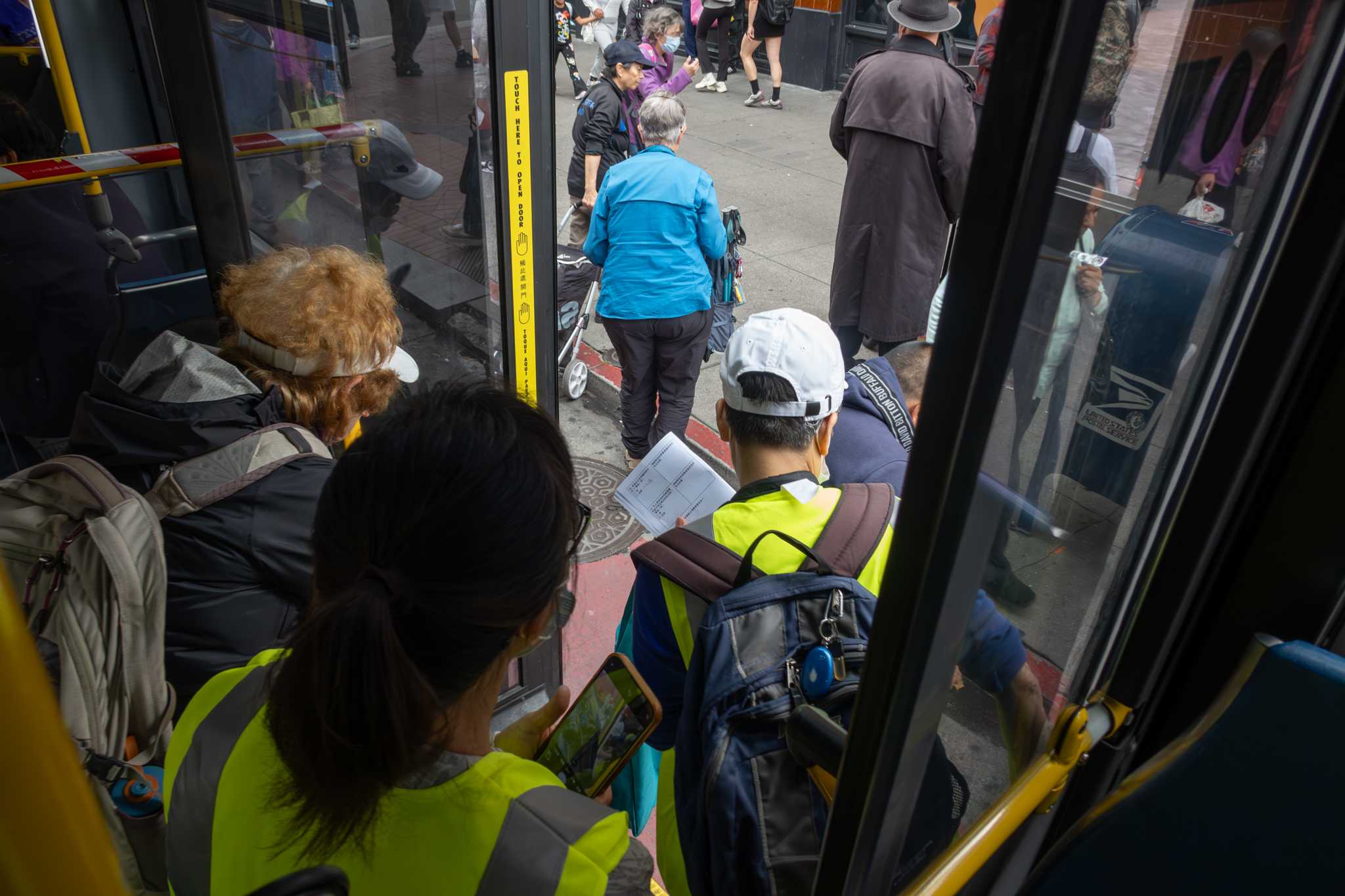
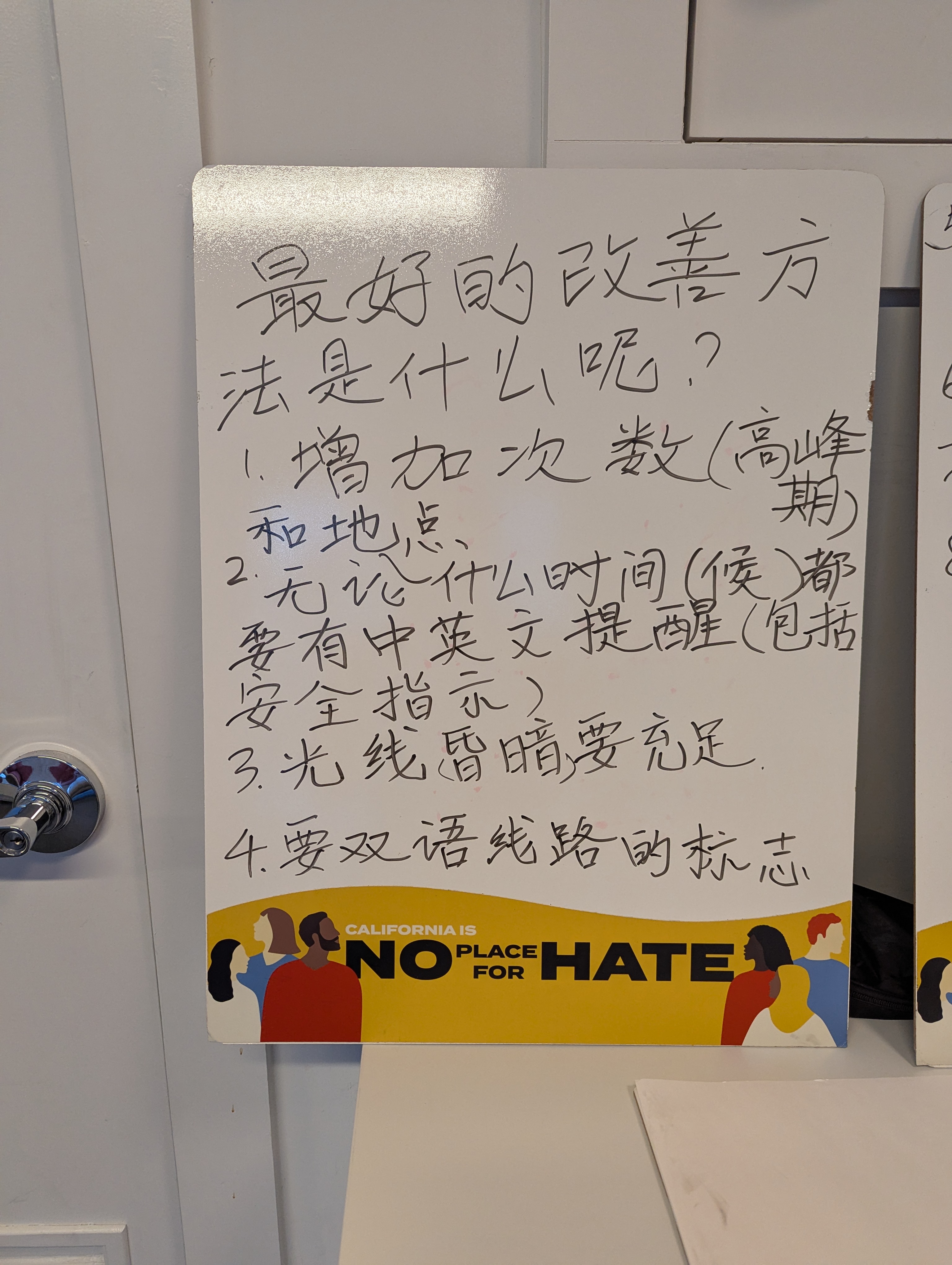
Caption: Above, resident auditors wearing neon vests exiting a bus and holding a notepad to write down data observations. Below, notes in Simplified Chinese from auditor debriefs about their rides.
Source: CAA Report, 2026
Although residents report feeling safe most of the time on the buses, they also shared events or conditions that contribute to feeling unsafe. Harassment, including verbal abuse, sexual harassment, and theft, were common concerns, often worsened by language barriers and a lack of support from authorities and bystanders. But their concerns were not limited to interpersonal incidents or crime. Residents also worried about getting lost due to limited multilingual announcements and signage to help them navigate. Many seniors and people with disabilities also described risk of falls and injuries as an equally big concern, feeling unsafe when boarding, exiting, or riding buses. Lastly, conflicts with other riders and fears of unpredictable behavior from some passengers also contributed to feelings of unease.
"He intentionally followed me and wanted to touch me. He followed me from the front to the back of the bus. My English was not that good, so I didn't know what to say. What should I say after I say 'help?' I have a language barrier." - Resident auditor
“On the bus, I saw seniors step on and the doors kept closing and didn’t open. They had to scream out loud to stop.” - Resident auditor
Residents Drafted Holistic Solutions to Improve Safety
Drawing on the community audits, feedback sessions, and their own past experiences, residents created a set of policy recommendations for SFMTA and other community stakeholders. CAA published a report in both Simplified Chinese and English with these recommendations and held a report launch event that provided an opportunity for community members to share their experiences and recommendations directly with representatives from the city and SFMTA and hear what city agencies were doing to improve safety.
While increased policing is often presented as a key solution to increasing safety on public transit, residents noted that ultimately, policing did not address infrastructure issues and root behaviors from other passengers that caused them to feel unsafe. Additionally, increased policing is not the most cost-effective solution. Residents recommended four solutions:
- Multilingual public education campaign: Residents recommended multilingual campaigns to make San Francisco’s bus culture kinder and more considerate. Suggested topics include: proper bus etiquette; accommodating seniors, disabled people, and pregnant people; gender- and race-based harassment; bystander training; and conflict navigation between different cultures and races. CAA referenced educational campaigns from London, New York City, San Francisco’s BART system, and cross-cultural conflict navigation trainings from San Francisco’s Coalition for Community Safety and Justice.
- Community ambassadors on transit: Residents suggested that SFMTA hire more staff and community ambassadors who are trained in support and de-escalation. Residents said they would feel safer seeing ambassadors on the buses and at bus stops so they can receive timely help and intervention. More staff also relieve pressure on bus drivers who must focus on safely operating their vehicles.
- Multilingual route information and wayfinding: Incorporating multilingual stop announcements, route maps, and physical bus stop markers can help residents who do not speak English fluently navigate commutes more easily and avoid getting lost.
- Increased frequency of buses during peak times: Residents expressed that more frequent buses during peak times could reduce crowding. Less crowded buses could help prevent physical falls, theft, and tension between riders.
These solutions can increase safety across multiple aspects for immigrant passengers, build trust between passengers and transit agencies, and ultimately, increase ridership for public transit.
Lessons for Other Communities
CAA’s community audits are an example of how a multilingual approach is essential because it makes transit planning more inclusive and addresses concerns affecting ridership and system sustainability. CAA identified a specific group within San Francisco that is often excluded due to income levels and language barriers. They created a space for community members to slow down and reflect on experiences they would otherwise rush past in their busy lives. Their entire audit process was conducted in Cantonese, ensuring that residents could voice their observations seamlessly and add their expertise.
Other transit agencies and community organizations can create similar initiatives by identifying specific neighborhoods that face challenges accessing and safely navigating public transit, and recruiting residents to shape the solutions. For neighborhoods with residents that speak languages other than English, organizations should host trainings, audits, and feedback sessions in those languages. Through this multilingual approach, residents can share their unique perspectives and pave the way for building stronger public transit systems across the country.